Finance
Key driver: Platform
One customer, many relationships
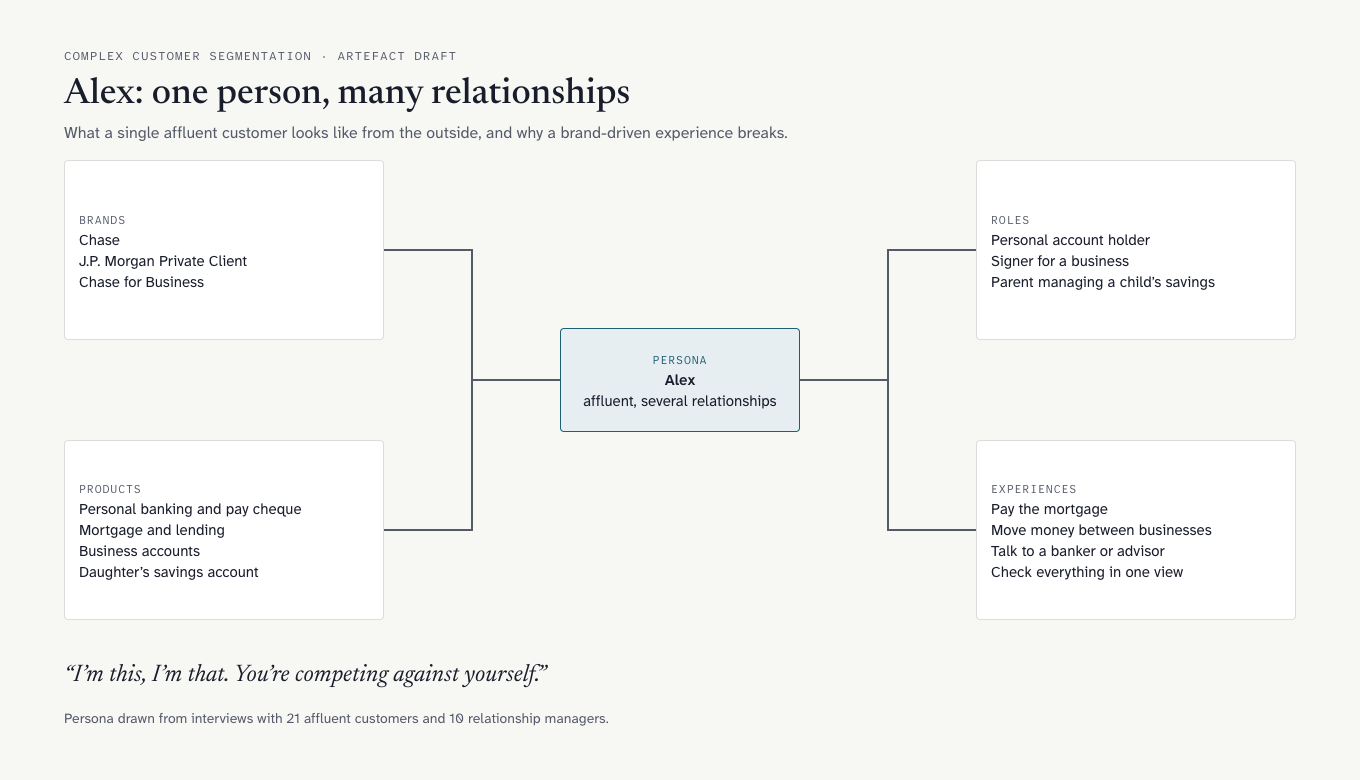
A private-banking client who also runs a business and pays a mortgage is one person to themselves, and several different customers to the bank. After 20 years of patched-together segmentation, about 5 million customers were tagged one way in one system and another way in the next.
My role
Lead service designer
Organisation
JPMorganChase, New York
When
Aug 2024 – Feb 2025
Research
21 affluent customers · 10 relationship managers
~5M
customers with conflicting segment tags between systems
9–12 mo
to add one new segment, because the logic was so tangled
~6×
the value of an average customer, for those with relationships across three or more businesses
01 · The problem
Our most valuable customers had the most confusing experience.
The experience was driven by brand. That works if you only have a checking account. It breaks for someone who is a private client, a business owner and a parent paying into a child's savings, and those were the customers the bank most wanted to keep.
Meet Alex
“I prefer a single consolidated view of all my accounts and a single point of contact, so I can see a complete picture of my finances.”
What customers saw
Brand
Two banks in one pocket.
One brand in the app, another on the web, and the wrong one in emails. Some customers suspected fraud; others thought they'd been downgraded.
Features
Things quietly disappeared.
Moving between tiers removed tools like wealth planning and budgeting, and raising a wire limit suddenly needed a branch visit.
Service
Bounced between teams.
Calls were passed between service centres, and relationship managers could be locked out when a client opened a new account.
In their words
“You might see Chase on one account, whereas it might be JPMorgan on another account. To me, it's somewhat confusing.” Business owner and CFO
“For clients with Private Bank accounts, we lose access to everything. We have to ask them to contact the 1-800 number.” Business relationship manager
“I want one person to talk to that can fix all my problems.” Affluent customer
02 · Behind the scenes
Seven ways of tagging a customer, each stretched past its purpose.
Over 20 years, different teams had built their own ways to segment customers: for ownership and reporting, marketing, the digital channels, VIP treatment, wealth tiers and more. Many were reused for jobs they were never designed for, and every workaround made the next change harder.
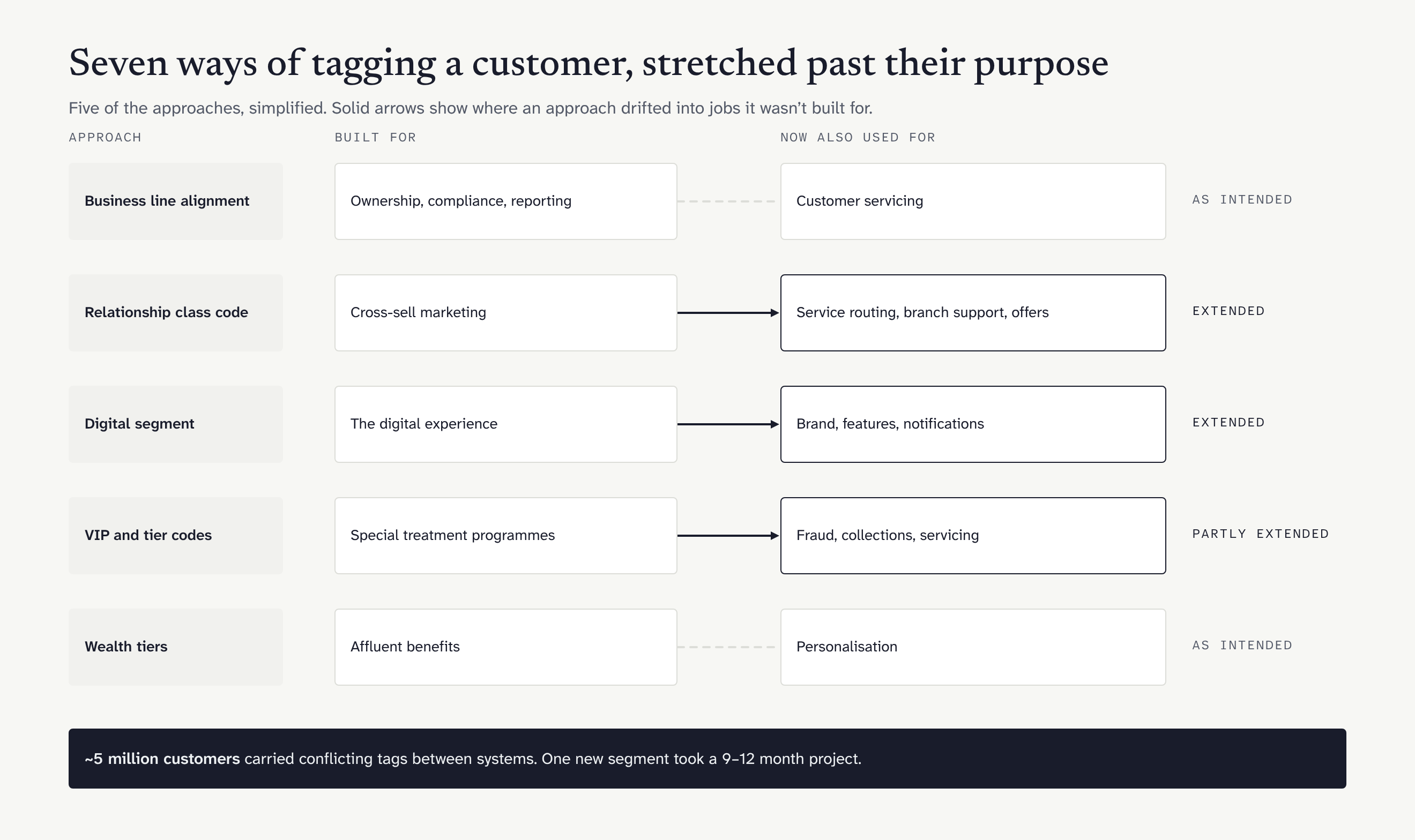

Three consequences: inconsistent experiences for anyone crossing organisational lines; slow, manual fixes (it took weeks every month to move thousands of business households to the right service model); and systems too tangled to change (one new segment meant a 9–12 month project).
03 · What we designed
From brand-driven to context-driven.
Instead of asking “which brand is this customer?”, work out their whole relationship and preferences, then build the experience from small, reusable parts we called experience objects. Each one turns data about the customer into something the app, the branch or the phone team can act on.
1 · Capture context
Every relationship and role, behaviour, and the preferences customers tell us.
2 · Experience objects
Brand expression and service tier first, then account view and login. One central source, calculated daily for each person.
3 · Consistent experience
App, web, branch, phone and relationship manager all read the same answer.
Fixing the data first
We redesigned how the segment is calculated: daily and for each person, then rolled up to the household, instead of monthly at household level. Before changing anything we checked the impact: over 95% of tens of millions of household codes stayed the same, and most changes were between low-risk codes.
One example: a spouse who only signed on a business account she didn't own had pulled her whole household into private banking. The new logic separates the household from the business.
Four stages
Stage 01
Segment calculated daily, per person
Effort: data medium; platform, digital and servicing low.
Stage 02
Digital channel's own rules folded in
Effort: data high; platform and digital medium; servicing low.
Stage 03
Experience objects for simple customers
Starting with one servicing feature. Effort: data and platform high; servicing medium.
Stage 04
Experience objects for complex customers
Every channel. Effort: data and platform high; digital and servicing medium.
The verdict
The tech teams agreed it was feasible on the existing customer-data platform and roadmap. We recommended a proof of concept for affluent customers, a steering committee across the affluent businesses, and an owner for every segment.
Expected impact: higher NPS, CSAT and customer effort scores, fewer calls, better channel containment and shorter handle times.
What happened
The data teams took ownership of experience objects and, when I left, were building and testing the first ones.
What I'd take to public services
Most of the “experience” problems here were data-model problems. Government has the same one: a single person, held as different records by every department.
More projects
2024
Content Velocity
JPMorganChase · Finance · AI
Getting guidance to call-centre specialists took 10 to 12 weeks. We found where the time went and shaped six ways to get it to two.

2023–24
Lost Card Lifeline
JPMorganChase · Finance
Every month 800,000+ Chase customers tried to replace a lost card themselves, and around 40% gave up partway.

Working on a regulated service?
I’m always glad to compare notes with people in finance, healthcare or the public sector, especially if you’re working out where AI belongs.